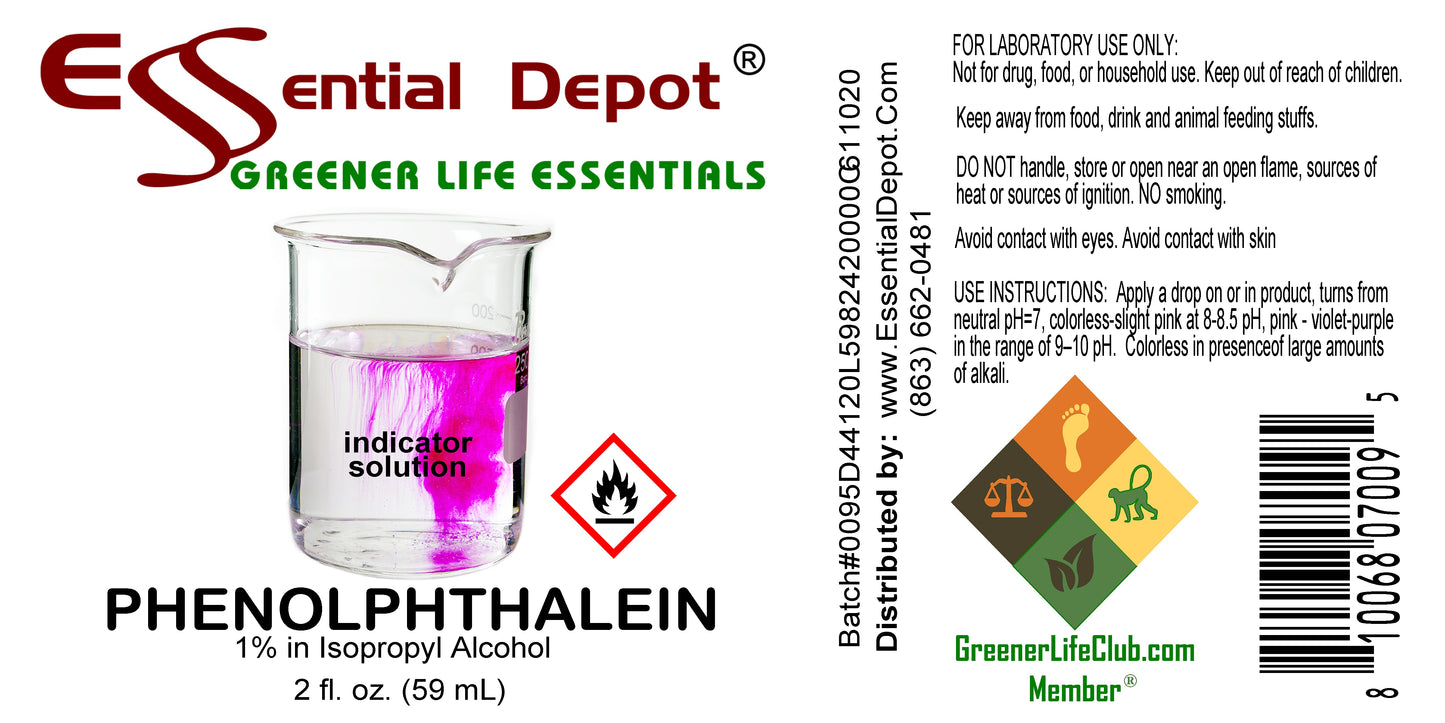
PHENOLPHTHALEIN 2oz bottle (59mL), 1% in Alcohol (Isopropyl/Ethanol), Indicator Solution, used in acid and base titrations, Made in the U.S.A., in flexible squeezable HDPE bottle with convenient flip top dropper cap
Commonly used with acid and base titrations. Also as a "neutralization" indicator for determining when excess base (such as sodium hydroxide or potassium hydroxide) is present.
COUNTRY OF ORIGIN: U.S.A.
APPEARANCE: clear, colorless
ODOR: characteristic odor of ethyl alcohol
Ready-to-Use HDPE squeezable bottle with a convenient resealable Flip Top Dropper Bottle
Tough and Durable
Refillable
Easy to handle
Keeps Indefinitely; NO Shelf-Life Limitations
Each bottle has safe handling and storage procedures printed directly on the label.
Manufactured in the USA by experienced chemists in a laboratory using strict quality control procedures.
DOCUMENTS: MSDS and COA available upon request.
FLASH POINT: 13C (Closed Cup)
pH: colorless at 8 - 8.5 pH, pink to violet/purple at 9 - 10, colorless in the presence of alkali in large amounts.
COMPOSITION:
Isopropyl (Ethyl) Alcohol 95%
Methyl Alcohol 1% - 5%
Phenolphthalein 1%.
USE INSTRUCTIONS:
Apply a drop on or in product, turns color from:
colorless at neutral pH=7,
colorless-slight pink at 8-8.5 pH,
pink - violet-purple in the range of 9–10 pH,
colorless in presence of strong alkali.
CAUTIONS:
FOR LABORATORY USE ONLY:
Not for drug, food, or household use. Keep out of reach of children.
Keep away from food, drink and animal feeding stuffs.
Wash hands thoroughly after handling. Avoid contact with eyes. Avoid contact with skin.
Keep container tightly closed in a cool, well-ventilated place.
DO NOT handle, store or open near an open flame, sources of heat or sources of ignition. NO smoking.
Protect material from direct sunlight.
Use only with adequate ventilation. Do not breathe fumes, gas, mist, vapors, or spray.
Watch Phenolphthalein React in Plain Tap Water:
Product Details
Country of Origin: USA
Color: Clear, Colorless
Flash Point: 13C (Closed Cup)
Skin Safe: No
Usage: In acid and base titrations. Also as a "neutralization" indicator for determining when excess base (such as sodium hydroxide or potassium hydroxide) is present.